
It is becoming increasingly clear that our culture faces a profound problem with the Law. Over recent years, the Epstein files have offered glimpses of the immense perversity festering behind the respectable façade of “high society.” In the United Kingdom, a series of investigations into the so-called “grooming gangs” has drawn back the curtain on comparable abuses in the non-elite strata of society.
A few weeks ago, British politician Rupert Lowe published The Rape Gang Inquiry Report. The report presents the findings of an investigation into the systematic sexual abuse of vulnerable British girls. The abuse was perpetrated by organised gangs consisting predominantly (reportedly around 95%) of Pakistani Muslims, commonly referred to as “grooming gangs.”
Investigations into these gangs are not new. Beginning in 2010, investigative journalist Andrew Norfolk published a series of articles in the British mainstream newspaper The Times exposing the organised sexual exploitation of underage girls in Northern England. His work attracted national attention in January 2011, when he revealed internal documents indicating that authorities in Rotherham had been aware of large-scale abuse for years without taking adequate action. In the years that followed, Norfolk published further investigative reports documenting similar abuses in towns including Rotherham, Rochdale, Keighley, and Derby.
Norfolk was not the first to raise the alarm about the grooming gangs. Victims, parents, social workers, and several local politicians had been drawing attention to the problem for years. For example, Member of Parliament Ann Cryer warned as early as the beginning of the 2000s about the organised sexual exploitation of underage girls in her constituency.
Following the conviction of a group of offenders in Rochdale, several investigations were launched in 2012 into the role of the police, social services, and other public bodies. These inquiries concluded that reports of sexual abuse had been made over many years but were either ignored or not treated with sufficient seriousness. Victims were frequently disbelieved or left unprotected, while government agencies repeatedly failed to share information effectively about the abuse.
In 2013, the Rotherham Metropolitan Borough Council commissioned an independent inquiry, chaired by Alexis Jay, into the grooming gangs. This resulted in the so-called Jay Report, which concluded that between 1997 and 2013 at least 1,400 girls from troubled families and the foster care system had become victims. Thirty-nine offenders were convicted, receiving prison sentences totalling 470 years.
The Oxford Serious Case Review (2015) examined similar events in Oxford. It found that a network of offenders had been able to exploit girls over an extended period while the responsible authorities failed to intervene effectively. The police, children’s services, and other agencies worked together inadequately, while clear warning signs were overlooked or misinterpreted.
The Telford Inquiry (2022) reached similar conclusions, finding that over several decades more than one thousand children in Telford had been victims of sexual exploitation. Once again, the pattern was strikingly similar: local authorities and other institutions repeatedly failed to protect victims, reports of abuse were insufficiently investigated, and concerns about protecting institutional reputations against accusations of racism appeared to outweigh the imperative of protecting vulnerable children.
In 2025, the British government commissioned a national audit under the leadership of Louise Casey. The Casey Report concluded that the total number of victims ran into the thousands but could not be determined precisely. Above all, it emphasised the profound failure of British institutions to respond adequately to the widespread abuse. Victims were routinely disbelieved or blamed for their own exploitation, while even extreme forms of abuse were frequently minimised.
Some investigations are still ongoing. Under Operation Beaconport, authorities in London alone are currently investigating approximately 9,000 suspected offences. This raises an important question: how should the criminal justice system respond to criminality on such an extraordinary scale?
The publication of Rupert Lowe’s new investigation—conducted in collaboration with survivors, victims’ relatives, experts from social services, law enforcement, politics, and the judiciary—makes this question even more pressing. The report estimates that there were at least 250,000 victims. How was this figure reached?
It is not based on a direct count but rather on an extrapolation from previous investigations. The authors calculated an average number of victims based on the figures established in earlier inquiries. They then multiplied this average by the total number of identified grooming gangs (at least 149 according to the report). Finally, they took into account the widely recognised fact that reported cases represent only a fraction of the true number of victims. On the basis of these three factors, they estimated that at least 250,000 victims were abused between 1955 and 2025.
The report does not specify the exact formula used to arrive at this estimate, and the precision of the figure can certainly be challenged. Nevertheless, there can be little doubt that the true number of victims runs into the tens of thousands.
Beyond the scale of the abuse, the nature of the crimes described is particularly shocking. The entire register of sexual sadism appears to have crossed from the realm of imagination into reality:
Girls as young as 11 were initially befriended by a young Muslim man who then treated the young child like an adult and would then start providing them with alcohol, drugs, and cigarettes. After a few months the girls would then be collected from school gates, care homes, and streets in taxis. They were taken to houses, flats, restaurants, and hotels where they were raped repeatedly by groups of men, tortured, filmed for blackmail, and told they were “white trash” or “kuffar” who merited punishment. Many became pregnant while still children. Some miscarried under trauma, others endured coerced abortions, and some gave birth to children who were later removed by the state. We found that the same unspeakable crimes occurred in at least 149 local authority districts – close to 40% of all such districts across the United Kingdom (see page 14 for our full map). Survivors described daily rapes, “red rooms” of extreme torture, trafficking between cities, and institutional disbelief that compounded their suffering. Some girls were even trafficked to the Middle East where they would endure Islamic marriage. (The Rape Gang Inquiry Report, pp. 7–8)
**
From a psychological perspective, perhaps the most remarkable aspect of this monstrous case is the blindness and/or passivity displayed by the state institutions involved in the face of such widespread atrocities:
“The NHS recorded genital injuries, multiple sexually transmitted infections in children as young as 13, pregnancies caused by rape, and suicide attempts, yet discharged victims back to their abusers without safeguarding referrals or trauma care. Schools observed older men collecting girls at the gates, heard disclosures of rape on school premises, and responded by excluding victims rather than protecting them.” (p. 9)
Even after the publication of the report, this pattern appears to continue. So far, I have found only one article in a mainstream newspaper – Germany’s Die Welt – that critically engages with the report’s findings. Apart from that, I have come across a number of fact-checks that cast the report in a negative light, for example by pointing out that the estimate of 250,000 victims is “not proven.”
The response of the authorities extends beyond mere blindness and passivity; they have also acted with remarkable determination to suppress virtually every form of protest against this dramatic situation. Following the authorities’ failure to stop abuse committed by Muslim grooming gangs, protests and riots broke out in Rotherham and elsewhere in the United Kingdom. In sharp contrast to the authorities’ earlier failure to deal effectively with the grooming gangs themselves, the police and the courts responded swiftly and forcefully to the rioters.
For example, a 17-year-old boy received a 20-month prison sentence after posting on Facebook: “Everyone and their dog should attack the Britannia Hotel.” A woman was sentenced to 31 months in prison after writing: “Mass deportation now, set fire to all the fucking hotels full of the bastards for all I care... If that makes me racist, so be it.”
When citizens take the law into their own hands, violence can easily escalate into vigilantism, often harming innocent people. In that respect, the government is right to suppress riots. However, if this is not accompanied by equally determined and effective action against the criminality that gave rise to those riots, it becomes exceedingly difficult to persuade the public not to resort to such measures. The best course of action – indeed, both an ethical obligation and the wisest strategic choice – is persistent non-violent resistance.
The British government has not confined itself to prosecuting genuine hate speech and incitement to violence. It has also recorded and, in some cases, arrested thousands of individuals in connection with so-called non-crime hate incidents. This Orwellian expression refers to an incident that does not constitute a criminal offence, but is nevertheless considered an expression of hostility towards a “protected group.”
The police are not required to establish that hatred or discrimination actually occurred; the perception of the complainant alone may be sufficient to justify recording the incident. In effect, the introduction of the non-crime hate incident amounts to the institutionalisation of a system of reporting and surveillance. It encourages citizens to report one another – but only in specific circumstances, namely when a “vulnerable” group is perceived to be the target. In the context of the grooming gangs, one must ask: who is the genuinely vulnerable group here? The implicit answer suggested by the British authorities appears to be: the Muslims associated with the grooming gangs. Really?
Although a non-crime hate incident is not a criminal offence and therefore cannot by itself result in a criminal record, a fine, a conviction, or imprisonment, such a record is not necessarily without consequences. It may remain in police databases for a period of time and can become relevant during enhanced background checks for positions in education, healthcare, or other professions of trust. Moreover, the experience of a police visit or possible arrest inevitably leaves those involved feeling intimidated and, to some extent, criminalised.
In a similar vein, the British government has increasingly barred certain public figures and influencers – for example, Eva Vlaardingerbroek – from entering the United Kingdom, not necessarily because they engaged in hate speech or incited violence, but because their views were considered potentially threatening to public order. In that respect, at least, the United Kingdom has certainly not pursued an open-borders policy.
A culture that fails so dramatically to apply the law consistently and justly inevitably loses the respect of other cultures. In one sense, this is understandable. A culture in which the law ceases to function effectively is, in an important respect, no longer fully a culture. It risks becoming vacant ground upon which other cultures – sometimes highly developed, but more often more primitive ones – establish themselves.
The question confronting Europeans is whether they are willing to continue sliding towards the abyss. Does there still remain within European civilisation the desire to rise again like a phoenix from its ashes? Is the soil of this culture still fertile enough to allow, in Nietzsche’s words, a new tree to grow from this deeply unsettling condition?
**
Psychologically speaking, what unfolds before our eyes is indeed a deeply unsettling landscape. On the one hand, contemporary woke culture has become extraordinarily sensitive to what it regards as “boundary violations.” It seeks to regulate by law how many seconds of eye contact one may make on public transport, to impose legal sanctions for the misuse of personal pronouns, sees the “manosphere” everywhere, and records or arrests individuals for so-called non-crime hate incidents. Yet at the same time, it stubbornly looks the other way while tens of thousands of British girls are systematically exploited, abused, and tortured.
The left-progressive position—today commonly identified with woke culture—has gradually become a mere semblance, a form usurped by the Ego. Behind such a semblance there inevitably grows the impulse towards its exact opposite. This is, I would argue, a psychological regularity: the tendencies that are repressed in order to maintain an appearance continue to gain strength beneath the surface, eventually manifesting themselves elsewhere.
Thus, beneath the appearance of the progressive-left identity there developed a remarkable sympathy for the figure who, in most respects, appears to be the very opposite of the woke individual: the Islamist extremist.
This sympathy should not be confused with love. In the end, it benefits no one. It harms, first and foremost, the victims of extremism. It also harms the woke individual, who becomes entirely absorbed in maintaining an appearance. Nor does it benefit the criminal extremist himself, whose criminality is indirectly reinforced, and it certainly does not benefit the vast majority of peaceful Muslims. Nothing fuels hostility towards Muslims more effectively than allowing crimes committed by Muslims to go unpunished.
Ultimately, the mechanism at work resembles a classic case of mass formation, in which woke culture selects a single object of fear and becomes blind to all other dangers. For the progressive-left mindset, that object – that scapegoat – is “the fascist.” Once the Ego’s emotional energy has become concentrated upon this single object, the field of attention narrows until virtually nothing else remains visible. Crimes committed by Muslims then fall almost entirely outside that field of awareness (see Figure). Even if tens of thousands of victims exist, reports concerning them may still be noticed, yet they carry little psychological weight because no psychic energy has been invested in their representation. By contrast, damage committed during riots – whether real or perceived – acquires immense psychological significance because it is associated with the object (”the fascist”) upon which the emotional investment has been concentrated.
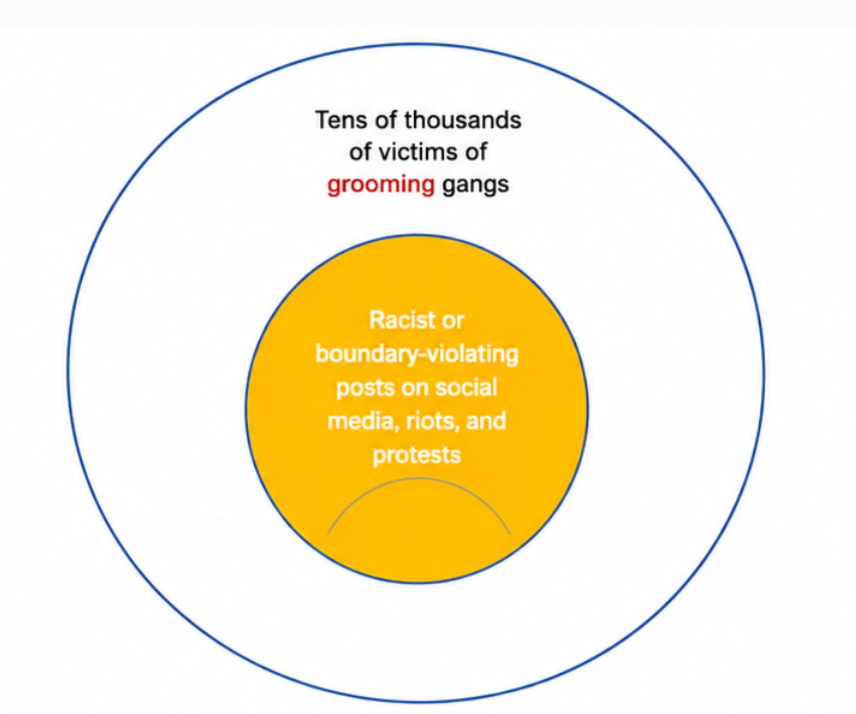
The progressive-left is, of course, not the only group susceptible to mass formation. I focus here on the left because I believe that, at present, its form of mass formation is the more dangerous. Mass formation – or its precursor, massification – arises whenever people seek to identify one individual or one group as the cause of society’s problems. Woke culture sees the danger of the far right everywhere; the genuine right-wing extremist blames migrants and socialists; the pro-Palestinian activist imagines that evil will disappear once the last Zionist has been defeated; the conspiracy theorist believes that without the corrupt elite the world would become harmonious overnight; and so on.
Anyone capable of preserving a measure of serenity can see how simplistic such assumptions are. If there are no Jews, Muslims, or woke activists to blame, human beings soon discover that they cannot even tolerate their neighbours. More fundamentally still, they are often so deeply divided within themselves that they struggle even to tolerate their own company.
Thus humanity drifts apart into separate masses, each imprisoned within the narrow circle of its own narcissistic Ego, each with its own ideal, its own object of fear, anger, and frustration. These Ego-circles contract until they no longer overlap, and emotional experience itself becomes fundamentally different from one group to another. Every possibility of genuine human recognition between groups disappears, and the words of the Other come to sound hollow and devoid of meaning.
If this isolation is to be overcome, if words are once again to acquire the power to resonate, human beings must detach their attention from their own convictions, ideals, and objects of fear. They must widen the Ego’s circle of attention until the perspective of the Other once again enters their field of awareness. This requires frustrating one’s own Ego – it requires sacrificing some of the gratification of one’s Ego-drives in order to listen sincerely to another person and, in turn, to speak sincerely oneself.
Without such a sacrifice, words cannot resonate and cannot create genuine human connection. This, I believe, is precisely what Aleksandr Solzhenitsyn sought to convey in his 1978 Harvard Commencement Address: Western civilisation is destined to fragment because nowhere within its materialistic worldview can it find a compelling reason to make sacrifices for the sake of truth.
Without that human bond—without the capacity to experience the Other as a fellow human being—the law itself can no longer be applied in a manner that is both consistent and humane. That, after all, is the very essence of justice: even in the criminal, one continues to recognise a human being.
The restoration of the Law therefore depends upon the restoration of Truth within our culture. In Western civilisation, propaganda—that is, organised falsehood—has increasingly become a central organising principle. As a consequence, lawlessness becomes almost inevitable, as it has in every bureaucratic and totalitarian system. Both Hannah Arendt and Aleksandr Solzhenitsyn described this process. One need only read the chapter “There Is No Law” in The Gulag Archipelago. The cases of the Epstein files and the grooming gangs in the United Kingdom suggest that we may be moving in a disturbingly similar direction.
The future, therefore, belongs neither to the political left nor to the political right; neither to Zionists nor to pro-Palestinian activists; neither to Jews, Muslims, nor the heirs of the Enlightenment. Ultimately, it belongs to every individual—Jew, Muslim, Christian, secular humanist; it makes no difference—who remains capable of sincerity and truthfulness.
From a psychological perspective, my conclusion is this: only a community united by the resonance of sincere speech can overcome the dictatorship of propagandised masses and bring the age of totalitarianism to an end – thereby restoring the Law to its proper place as Law.
M.D.

Thank you Mattias for this cool and clear appeal to our common humanity in these overheated times. I would only demur on one point. You make Wokeism sound like one more position on the spectrum of disturbed opinion, whereas the truth of the matter surely is that it has become systematically intertwined with the power of the State, and hence cannot be counted as just another form of extremism. The fact that Wokeism is enforced by the State, to the point where crimes against its tenets are treated as actual crimes even when they break no law, illustrates this point clearly enough. So there is no question of a level playing field here: Wokeists have the full force of the State behind them, both when it comes to enforcement of their prejudices and to the minimisation of the crimes they have helped to cover up. So while I agree with your plea to see all people as equally human, there are major structural issues here also which need to be addressed.
Even adult women are very often disbelieved, neglected (all the test boxes that waited for years to be examined - I think that was UK as well), ridiculed. These poor girls, a life long trauma, if they even survived the monstruosities. Is it because the 'elite' or should we say, the useless eaters, that are our governments, love to do the same as these gang? When is justice going to do its job? Never, I guess, because I read quite a few justices are involved as well.