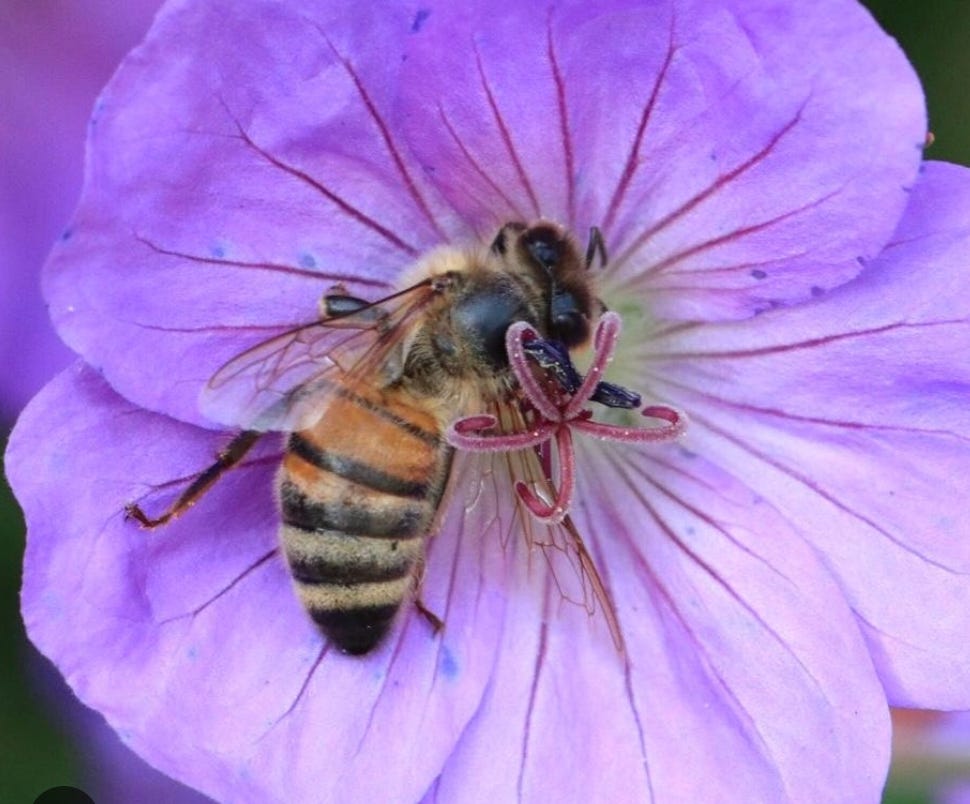
Honey sellers are now legally prohibited from claiming that honey is healthy — I read it in a Dutch newspaper this week. The measure is part of European legislation that prohibits “medical claims” in the food industry. From now on, you're only allowed to say something is healthy if it is "scientifically proven." That those "scientific proofs" often turn out to be incorrect and sponsored by the pharmaceutical industry is a concern for another time.
I am increasingly gaining respect for the bees, the plants, and the trees, and the healthy honey they produce together in a breathtakingly intelligent way, without having read a single peer-reviewed article.
Without sarcasm, irony, or mockery: I honestly don't think that science should primarily aim to "improve nature." Anyone with their eyes open can see that nature has a subtlety and beauty that cannot be improved. Humans can and must play a role in it, participate in it, but once we start believing that we can do better than nature, things start to go wrong.
I’ve just returned from a week-long stay at CERN in Geneva, the world’s most renowned institute for research on elementary particles. That research offers us something truly revolutionary about the nature of the reality we live in. Science, in that sense, belongs to the greatest achievements of human civilization. But the moment we use science to manipulate nature, its value — in my opinion — easily shifts from positive to negative, from productive to destructive. Just ask Oppenheimer.
I would rather say: science’s purpose is to uncover the beauty of nature, to remove the scales from the human eye so that we might better perceive the sublime structure of nature — and become silent, grateful witnesses of it.
When Aldous Huxley took zero point four gram of mescaline and entered the Egoless state, this was exactly what he experienced: he suddenly saw the beauty of the mere Being. Following the medieval Christian mystic Meister Eckhart he called that the “Isness” of things. The intensity of the aesthetic experience was such that even the strongest hunger couldn’t distract his attention from a bunch of flowers. Had the mescaline experience not ended, he believed, you would die there from sheer hunger, your soul absorbed by the essence of a flower.
I’m not promoting mescaline — I’ve never tried it and don’t plan to anytime soon. But that Huxley’s state might be meaningful for those who believe we need to overturn all of nature in order to find happiness — that, I do believe. Close your eyes and try a spoonful of healthy honey — for a moment you might find your destiny in it.
Mattias